When thinking of contemporary digital art, the reflex is to look towards Parisian festivals or galleries in major cities. Trixhentzi establishes its artistic practice far from urban centers, directly in rural Brittany. This positioning is not a logistical accident; it is a production choice that redefines how a figure in digital art can operate on a daily basis.
Trixhentzi and the Breton hybrid model: residency, production, and dissemination in the same place
Most structures dedicated to digital art separate three functions: residency (where the artist creates), technical production (where the equipment is available), and dissemination (where the public sees the result). Trixhentzi brings these three aspects together in a unique and sustainable location. We are no longer in the classic format of a one-off festival or temporary residency.
An artist in residence has direct access to technical support and production tools on-site. The exhibition or public screening takes place in the same space, without transport or delay. This short circuit between creation and dissemination reduces the friction experienced by those who have previously set up a digital installation in a venue not designed for it.
A detailed analysis of this approach can be found in digital art according to Trixhentzi on BreizhPower – The 100% Breton magazine!, which describes how this integration shapes the project’s identity.
Funding digital art in rural areas: what Trixhentzi is changing
Setting up a contemporary digital art project outside major cities presents a concrete problem: public cultural budgets are concentrated in metropolitan areas. Trixhentzi is part of cross-funding strategies that combine Breton local authorities, local cultural networks, and private partnerships.
The stated goal is to redirect a portion of public and private support towards areas traditionally under-resourced in digital art structures. This is not a circumstantial discourse: the project is designed from the outset as a lever to attract these budgets to rural Brittany.
Why local authorities are on board
For a municipality or intercommunal entity, co-funding a hybrid structure like Trixhentzi provides a measurable return: regular public events, mediation workshops, cultural attendance outside the tourist season. The feedback on this point varies by territory, but the model addresses an identified need in rural areas.
The financial setup is not replicable everywhere. It depends on the commitment of convinced local actors and a presence that is sustainable, not based on the logic of annual project calls.
Mediation and non-specialist audiences: Trixhentzi’s ground strategy
Contemporary digital art often suffers from a lack of audience outside initiated circles. Trixhentzi places mediation with audiences unfamiliar with digital art at the center of its operation, not on the periphery.
The initiatives implemented are not limited to guided tours. We are talking about practical workshops, meeting times integrated into the venue’s calendar, and educational formats designed for people who have never stepped into a contemporary art gallery.
What this changes in the way artworks are presented
When the target audience is not a professional from the art world, the scenography and discourse around the artworks must adapt. At Trixhentzi, this involves several concrete choices:
- Scheduled exchange times between artists and visitors, not reserved for openings
- Digital practice workshops open to local residents, with no technical prerequisites
- Accessible documentation of the exhibited works, designed for people discovering digital art
This mediation approach directly influences the style of the works hosted. Artists in residence know they are producing for a mixed local audience, not just for a jury of peers or a curator.
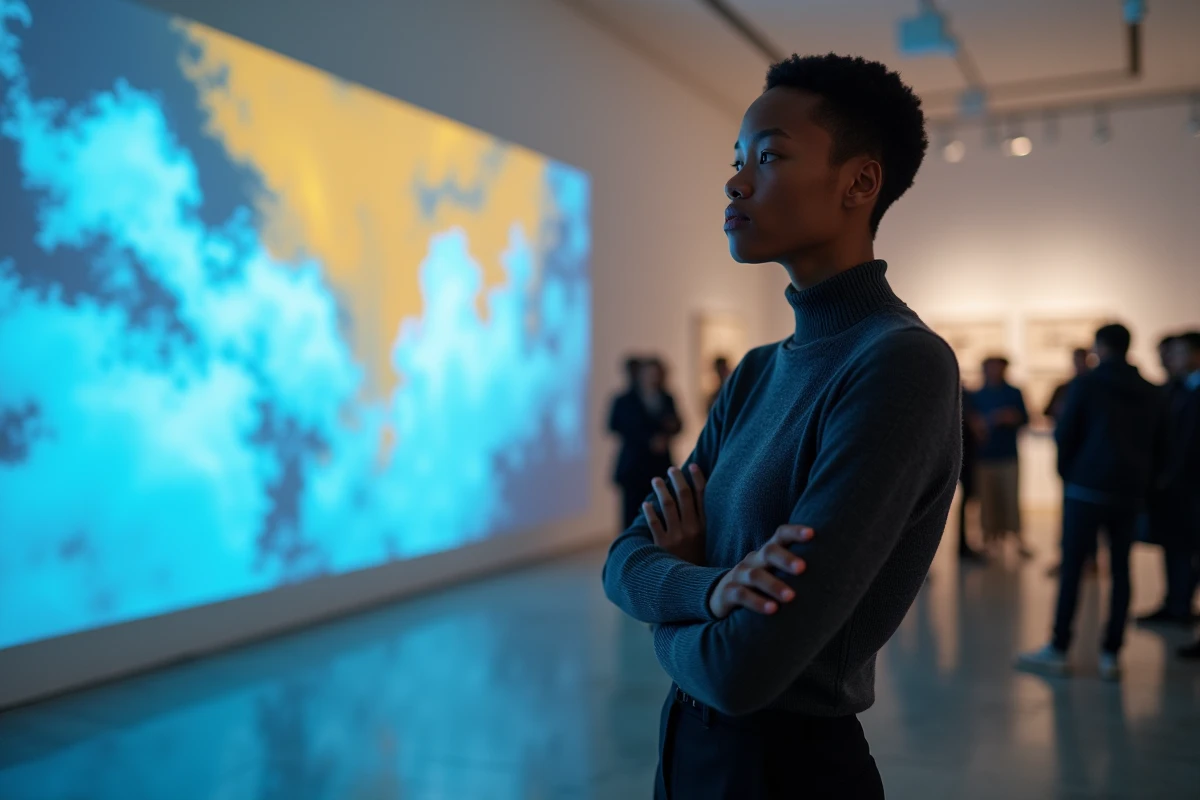
Contemporary digital art outside metropolitan areas: an alternative to usual circuits
Trixhentzi’s choice to establish itself in rural Brittany is not a militant stance disconnected from the field. It is an operational response to a simple observation: the distribution circuits of digital art remain concentrated in a few cities, which effectively excludes a large portion of audiences and artists.
By combining residency, production, and exhibition in a sustainable structure, Trixhentzi offers a counter-model to ephemeral festivals. The continuity of the venue allows for building a lasting relationship with the territory, its inhabitants, and its funders.
Artists who pass through benefit from a stable working environment, far from the race for project calls. Local visitors discover digital works without having to travel to a big city. And local authorities find a structuring cultural project capable of generating regular activity in a rural area.
This model does not claim to replace large urban institutions. It constitutes a sustainable digital art structure rooted in rural areas, with a requirement for professional production and a genuine openness to non-specialist audiences. The future will depend on the project’s ability to maintain this balance between artistic ambition and local anchoring.