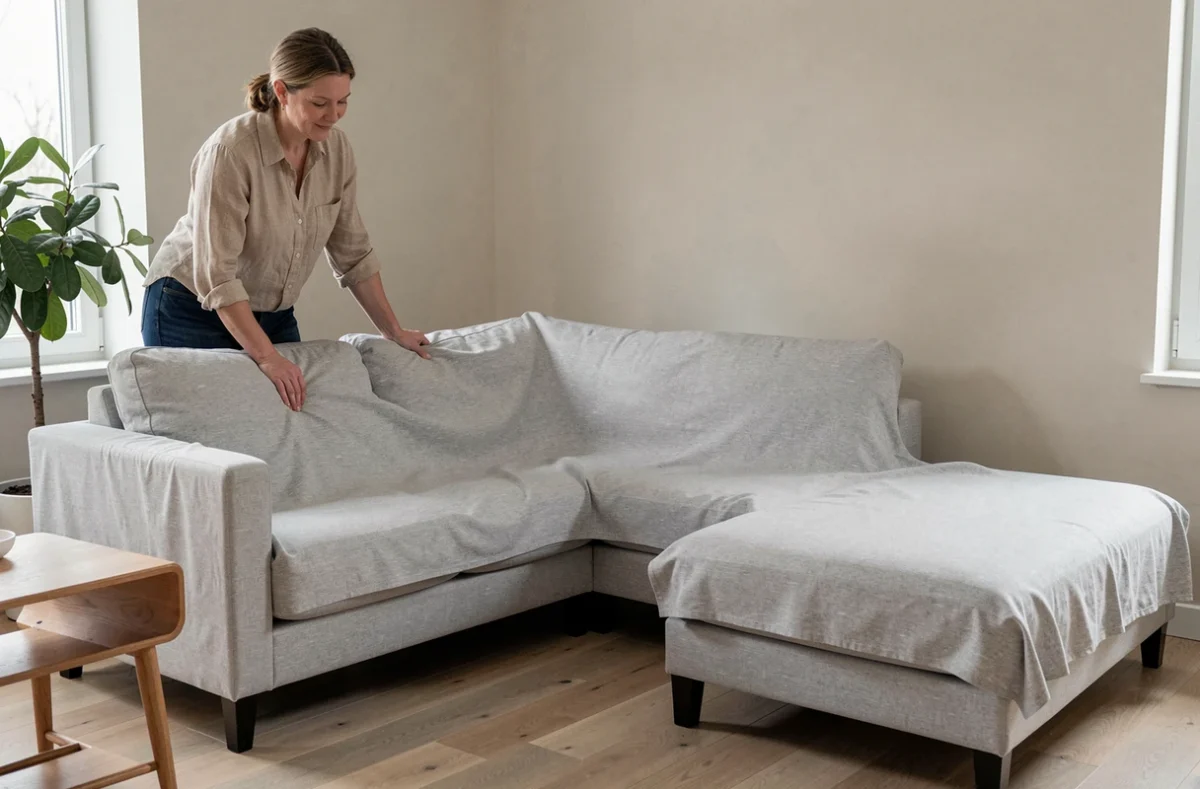
The corner sofas sold at Conforama come in various configurations: left or right chaise, convertible module with storage, wide or narrow armrests, fixed or removable cushions. This diversity complicates the choice of a suitable cover, as the dimensions displayed on a product sheet do not always guarantee a proper fit. The actual geometry of the sofa, its original fabric, and daily use weigh as heavily as size in the success of the purchase.
Geometry of the Conforama Corner Sofa: What the Product Sheet Doesn’t Say
Most guides focus on width and depth. For a corner sofa, these two measurements are insufficient. The height of the armrests, the thickness of the backrest, the curve of the chaise, and the possible presence of a pouf or storage modify how a cover fits the structure.
On several Conforama models (such as the Bobochic, Fuji, Nihad ranges), the corner is not always a strict right angle. Some feature a gentle curve at the junction, while others have a return shorter than the main part. A cover designed for a symmetrical L-shape will then leave unsightly wrinkles or, worse, pull on the fabric at the junction.
Before any purchase, five points must be measured: the total length of each arm of the L, the seat depth, the height of the backrest from the seat, and the height of the armrests. These measurements should be taken with the sofa empty and the cushions removed. A discrepancy of a few centimeters between the actual sofa and the dimensions stated by the cover manufacturer is enough to turn the whole thing into a poorly fitted sheet.
A complete guide on Conforama sofa covers details the measurements to take for each configuration, which helps avoid unnecessary returns.
Stretch Cover or Multi-Piece Cover: Decide Based on Use
Two main families of covers dominate the corner sofa market. The choice between them depends less on budget than on frequency of use and type of demand.
One-Piece Stretch Cover
This is suitable for monobloc corner sofas with a fixed angle. The elastic fabric adapts to the shapes, but elasticity does not compensate for a discrepancy of more than ten centimeters between the dimensions of the cover and those of the sofa. On a model that is too large, the cover constantly slips. On a model that is too small, the seams are under tension, and the lifespan decreases.
Modular Multi-Piece Cover
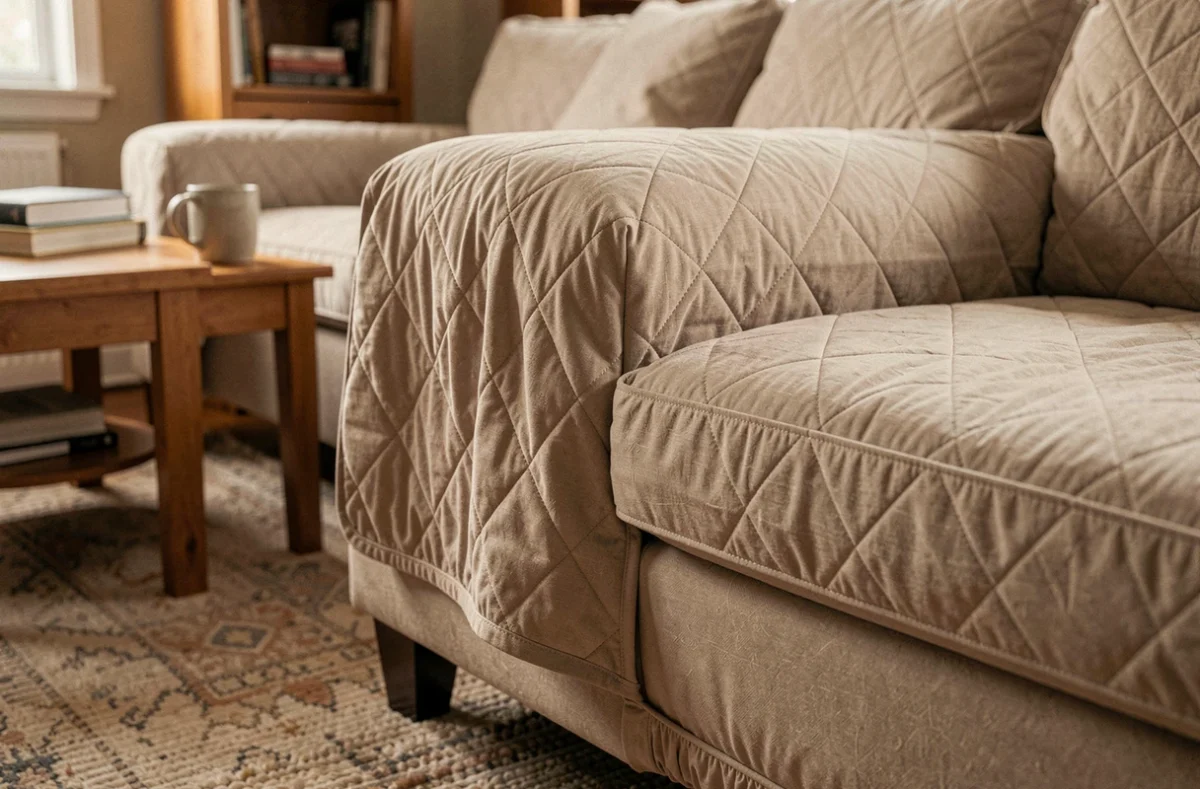
This is preferable for sofas with separable modules (common at Conforama in convertible ranges with storage). Each section receives its own cover, which simplifies installation and washing. User feedback varies on this point: some find that the junctions between pieces create visible wrinkles, while others believe that the freedom of repositioning more than compensates for this aesthetic flaw.
- If the sofa is used daily by a family with children or pets, the multi-piece cover makes it easy to replace just one stained section without removing everything.
- If the goal is primarily decorative (changing color, harmonizing with a new room style), the one-piece stretch cover offers a more uniform appearance.
- If the sofa has a removable chaise, a monobloc cover may not adequately cover the detachable part.
Cover Fabric for Corner Sofas: Polyester, Cotton, or Linen
The choice of fabric determines comfort, maintenance, and longevity. The compromises are rarely clearly stated.
Polyester withstands friction well and generally retains its shape after several washes. However, it can accumulate static electricity and attract dust, which is problematic in a living room exposed to direct light or frequented by long-haired pets.
Linen offers a pleasant coolness in summer and a natural look that pairs well with Scandinavian design or a beige and wood interior. It wrinkles easily and requires more care when washing. For a corner sofa used every day, it is not the most practical fabric.
Cotton remains the most common compromise, but one detail deserves attention. Unsanforized cotton can shrink in the first wash, which permanently alters the fit of the cover. On a corner sofa where the fabric pieces are large, even moderate shrinkage is enough to create tension at the seams and expose the armrests. Checking for the label “sanforized” or “pre-washed” helps avoid this disappointment.
Maintenance and Washing: Pitfalls to Check Before Purchase
The mention “removable cushions” on a Conforama product sheet does not guarantee that the cover is machine washable. This indication means that the cushions can be removed from the sofa, not necessarily that their covering detaches for washing. To ensure easy maintenance, one must explicitly look for the terms removable cover and indicated washing temperature.
The drying method is as important as washing. Long-pile velvet, sometimes used on decorative covers, risks losing its texture in the dryer. For a corner sofa whose cover covers a large area, flat drying or drying on a rack remains the safest method, even if it requires space.
- Check for the mention “machine washable” and the maximum tolerated temperature (often indicated in degrees on the label).
- Prefer a pre-washed or sanforized fabric if the cover is cotton, to avoid shrinkage.
- Avoid the dryer for velvet or pile fabric covers; prefer air drying.
Keeping the Cover on a Corner Sofa: Fixation and Non-Slip
A cover that slips after a few hours of use ends up not being used at all. On a corner sofa, the surface is larger and the pulling forces are more distributed, which amplifies the problem.
Retention systems vary: elastic bands under the seat, foam rods to slide into the gaps between cushions, non-slip pads glued under the cover. Foam rods inserted into the folds provide the most reliable hold on corner sofas, as they block the fabric at the junction between the seat and backrest, where slipping begins.
Non-slip pads work better on smooth surfaces (faux leather, vinyl) than on textured fabric. If the original Conforama sofa is covered in rough fabric, the natural grip between the two textiles may suffice without additional accessories.
The choice of a cover for a corner sofa relies on concrete checks: precise measurements beyond simple width, fabric suited to actual use, maintenance label read in detail, retention system compatible with the original covering. These technical criteria weigh more than color or pattern in long-term satisfaction.